L2TP Data SIMs: Mobile Data Delivered to Your LNS
Netavo L2TP data SIMs deliver mobile data to your own network the way wholesale broadband is delivered. Each SIM's data session arrives at your LNS as a PPP session inside an L2TP tunnel, your RADIUS authenticates it and assigns its address, and from there it is your traffic, on your network, under your policy.
Mobile data that lands on your network
Most data SIMs hand their traffic to the internet, or to a private network their provider runs. An L2TP data SIM hands it to you. Netavo's mobile core carries each SIM's data session as a PPP session inside an L2TP tunnel, and delivers that tunnel to your L2TP Network Server, the LNS.
Your LNS terminates the session exactly as it would a broadband subscriber's. Your RADIUS decides whether the SIM may connect and which address it gets, and your accounting records what it uses. The SIM becomes another subscriber on a network you already run.
- Each SIMOne PPP session, tunnelled over L2TP
- AuthenticationYour RADIUS
- AddressingAssigned by you, static or dynamic
- Terminated onYour LNS, or Netavo BNG
- NetworksAll four in the UK, more than one abroad
From the SIM to your LNS
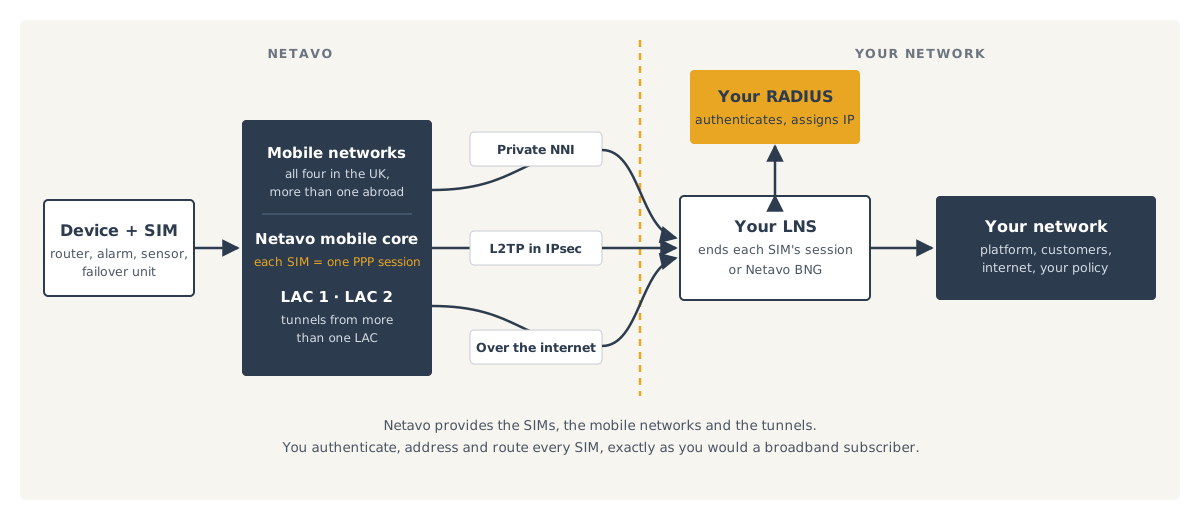
What happens when a SIM connects
The SIM attaches
The device's SIM attaches to whichever mobile network it can use at that location, and opens a data session through Netavo's mobile core.
The session is tunnelled
Netavo's LAC carries the session to your LNS as a PPP session inside an L2TP tunnel, alongside every other SIM in your fleet.
Your RADIUS decides
Your LNS asks your RADIUS whether the SIM may connect. If it may, RADIUS returns the address and any policy that applies to it.
Traffic joins your network
The SIM's traffic now enters your network at your LNS. Where it goes next, the internet, a platform or a customer network, is your routing and your policy.
Three ways to reach your LNS
The tunnels can reach you however suits your network, and more than one way at once.
| Transport | How it works | Suited to |
|---|---|---|
| Private interconnect | A direct on-net NNI between our network and yours, at Telehouse North, Telehouse East or Pulsant Manchester | Larger fleets, and networks already present in those datacentres |
| L2TP inside IPsec | The L2TP tunnels carried inside an encrypted IPsec tunnel to your network | Any network with internet connectivity that wants the tunnels encrypted in transit |
| Over the internet | The L2TP tunnels sent directly to your LNS across the internet | Testing, smaller fleets, and traffic your devices already encrypt end to end |
Built to stay up
Tunnels reach your LNS from more than one Netavo LAC, so the loss of one does not take a fleet offline. A SIM whose session drops simply reconnects through a tunnel that is still up.
Because your RADIUS assigns the address, a SIM can keep the same static address whichever tunnel or LAC it arrives through. Point the tunnels at more than one LNS of your own, and your side of the path is resilient too.
- Netavo sideTunnels from more than one LAC
- Your sideAs many LNSs as you run
- Static addressesKept, because your RADIUS assigns them
Who uses L2TP data SIMs
| Who | What they use them for |
|---|---|
| ISPs and altnets | Mobile backup and 4G or 5G broadband for their own subscribers, terminated on the LNS they already run, with the addresses and policy they already manage |
| MSPs and IT providers | Mobile failover and site connectivity for business customers, landing on the provider's own network so it can be managed and secured centrally |
| IoT platform operators | Device fleets that arrive on the operator's network with the operator's own addressing, ready to reach the platform without per-device VPNs |
| Alarm and telemetry providers | Signalling and monitoring devices that must reach a private receiving platform, never the public internet |
L2TP compared with other ways to reach a fleet
| Approach | Who authenticates and addresses SIMs | Best when |
|---|---|---|
| L2TP to your LNS | You, with your own RADIUS | You already run subscriber infrastructure, or want full control of addressing and policy |
| Private SIM network with IPsec | Netavo, within a private network for your fleet | You want a private fleet without running an LNS or RADIUS |
| Cloud interconnect | Netavo, delivered into your cloud environment | Devices report to systems in AWS or Azure |
| Public internet access | Netavo, with public or private addressing | Devices need only general internet access |
No LNS of your own? Use ours
L2TP data SIMs are most often terminated on an LNS the customer already runs. If you do not have one, Netavo BNG can be your LNS: our software broadband network gateway terminates L2TP sessions with the same per-SIM authentication and addressing.
Netavo BNG →- Most commonYour own LNS, in your network
- AlternativeNetavo BNG as the LNS
The SIMs themselves
L2TP delivery changes where a SIM's traffic goes, not the SIM. The same coverage and options apply.
| Option | Detail |
|---|---|
| Coverage | All four UK mobile networks on one SIM, and more than one network in countries around the world |
| Formats | eSIM by QR code, or physical SIMs in standard and industrial MFF2 formats |
| Data | Allowances per SIM, or pooled across a fleet |
| Network selection | Steering policy set for each fleet |
| Management | Activation, suspension and usage reporting in the portal and by API |
Common questions
What is an L2TP data SIM?
An L2TP data SIM is a mobile data SIM whose sessions are delivered to the customer's own network over L2TP. Each SIM's session arrives at the customer's LNS as a PPP session, like a wholesale broadband subscriber.
Can I terminate mobile data SIMs on my own LNS?
Yes. Netavo tunnels each SIM's data session over L2TP to your LNS, which terminates it exactly as it would a broadband subscriber's session.
Can I use my own RADIUS with Netavo data SIMs?
Yes. With L2TP delivery your RADIUS authenticates each SIM and assigns its IP address, so you control access, addressing and policy.
Can an L2TP data SIM have a static IP address?
Yes. Your RADIUS assigns each SIM's address, so a SIM can keep the same static address on every connection, whichever tunnel it arrives through.
Is L2TP encrypted?
L2TP itself does not encrypt traffic. Netavo can carry the L2TP tunnels inside IPsec, or deliver them over a private interconnect, where encryption in transit is required.
How do the L2TP tunnels reach my network?
Over a direct on-net NNI at Telehouse North, Telehouse East or Pulsant Manchester, inside an IPsec tunnel, or across the internet, from more than one Netavo LAC.
What if I do not run an LNS?
Netavo BNG can be your LNS. It is Netavo's software broadband network gateway, and terminates L2TP sessions with the same per-SIM authentication and addressing.
Which mobile networks do L2TP data SIMs use?
The same as every Netavo SIM: all four UK mobile networks on one SIM, and more than one network in countries around the world.
Often delivered alongside
IoT & Mobile Data
Global multi-network SIMs on our own mobile core, with internet access or a private network for device fleets.
Explore IoT →ISP Network Services
IP transit, backhaul and L2TP broadband for internet service providers and network operators.
Explore ISP services →ISP BNG & CGNAT Systems
Netavo BNG, a carrier-grade x86-based BNG and CGNAT platform for internet service providers.
Explore BNG and CGNAT →Discuss L2TP data SIMs
Tell us about your LNS and RADIUS, how you would like the tunnels to reach you, and roughly how many SIMs you expect. An engineer will respond with a recommended design and pricing.
Work with us →