How local internet breakout works
Local breakout moves the point at which mobile traffic meets the internet. Instead of travelling back to the operator's home network, a subscriber's traffic is handed to a Netavo breakout point in the region they are in, and reaches the internet from there.
Two routes to the internet
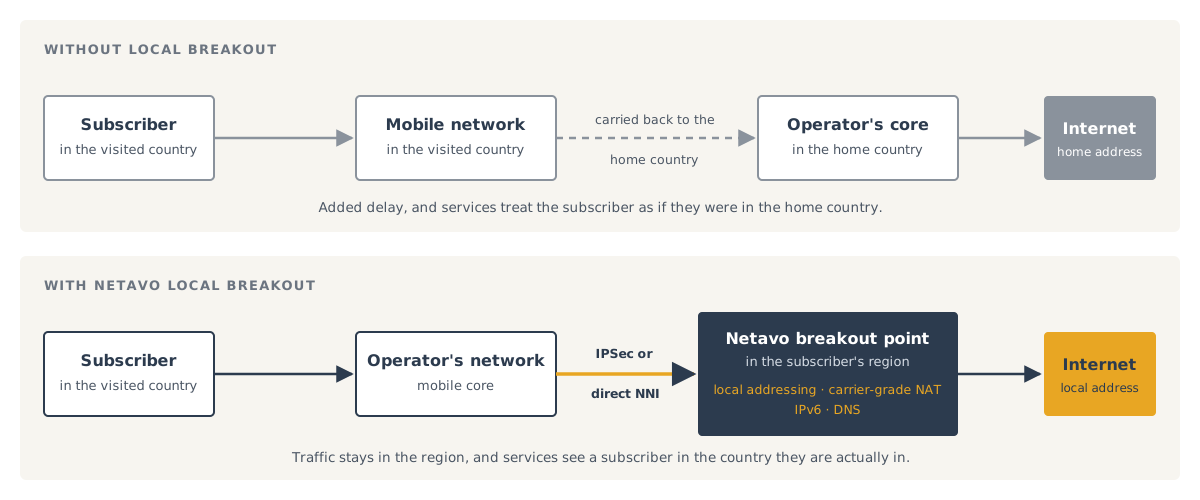
The problem with carrying traffic home
Sending a roaming subscriber's traffic back to the home network is simple for the operator, and it is how most roaming data has always worked. Its costs fall on the subscriber.
The first is delay: every request crosses the distance to the home country and back. The second is location. The address the subscriber appears to come from belongs to the home country, and much of the internet decides what to show, and whether to work at all, from that address.
- DelayEvery request travels to the home country and back
- LanguageSites answer in the home country's language
- ContentLocal services are unavailable, or the wrong catalogue is offered
- TrustSign-ins and payments flagged as coming from abroad
What happens at a breakout point
Each breakout point is Netavo's own equipment in a datacentre in the region it serves.
| Function | What it does |
|---|---|
| Local public addressing | Traffic leaves from addresses registered in the country the subscriber is in |
| Carrier-grade NAT | Many subscribers share public addresses, translated at the breakout point |
| IPv6 | Native IPv6 to the internet, alongside IPv4 |
| DNS | Names resolved locally, so services direct the subscriber to their nearest servers |
| Interconnection | Traffic received from the operator over IPSec or a direct on-net NNI |
Why local DNS matters as much as a local address
Large internet services keep copies of their content in many places and use DNS to send each user to the nearest one. If a subscriber's names are resolved in the home country, they are sent to servers near the home country, even when their traffic leaves locally.
Resolving names at the breakout point keeps the two consistent: the address is local, and so are the servers the subscriber is directed to.
- AddressLocal to the subscriber
- DNSResolved at the breakout point
- ResultContent served from nearby
The path of one request
From the device
The subscriber's device attaches to a mobile network in the country it is in, as it would for any roaming session.
Through the operator
The operator's mobile core hands the subscriber's traffic to Netavo over IPSec or a direct interconnect.
At the breakout point
The traffic is given a local address, names are resolved locally, and it is released to the internet in the region.
And back
Replies return the same way, so the whole exchange stays within the region.
Discuss a breakout design
Tell us where your subscribers are and how your core hands off traffic today. An engineer will respond with how breakout would be designed for it.
Work with us →